
Two Designs for Plate Borders
19th century
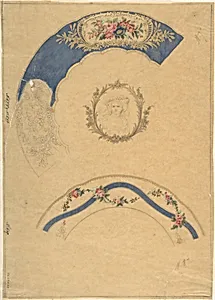
Medium
Graphite, watercolor, gouache, and gold gilt. Framing lines in graphite.
Dimensions
sheet: 9 5/8 x 13 9/16 in. (24.4 x 34.4 cm)
Classification
Drawings
Department
Drawings and Prints
Museum
Metropolitan Museum of Art, New York, NY
Credit
The Elisha Whittelsey Collection, The Elisha Whittelsey Fund, 1953
Accession Number
53.675.29
Rights
Public Domain
Tags
Art Historical Context
Step into the refined world of 19th French decorative arts with *Two Designs for Plate Borders an exquisite anonymous drawing from the Metropolitan Museum of Art Elisha Whittelsey Collection. Created as preparatory sketches for elegant plate rims, these designs feature graceful portraits of women intertwined with blooming flowers—a nod to the era's Romantic fascination with beauty, femininity, and nature. Such border motifs were essential for luxury porcelain manufacturers like Sèvres, adorning fine tableware for the elite during France's booming decorative arts scene. The artwork masterfully combines graphite for precise framing lines and underdrawings with vibrant watercolor and gouache for rich, opaque colors, crowned by shimmering gold gilt that evokes opulent porcelain finishes. Gouache's matte density allowed artists to mimic the glossy sheen of ceramics, while the gold added a touch of grandeur, bridging fine art sketches with functional design. At 9⅝ × 13⅙ inches, this sheet captures the meticulous planning behind everyday luxury objects. These designs highlight the anonymous craft of 19th-century ateliers, where skilled draftsmen fueled France's porcelain industry, blending portraiture and floral symbolism to celebrate idealized womanhood. A gem of the Met's Drawings and Prints department, it invites us to appreciate the artistry behind the dinner table.
About the Artist
Anonymous, French, 19th century · 1800–1900
**Anonymous, French, 19th Century (ca. 1800–1900)** The artist cataloged as Anonymous, French, 19th century embodies the enigmatic yet essential contributions of unidentified creators to France's vibrant 19th-century art world. Active roughly between 1800 and 1900, this figure—or potentially collective workshop—produced a diverse array of works amid the nation's transition from Neoclassicism thro...