
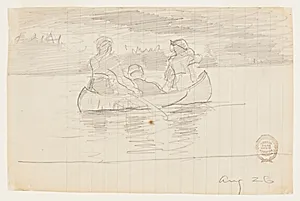
Three Men in a Canoe, Il Manigne, Quebec
August 26, 1897
Classification
landscapes
Department
Smithsonian Collection
Museum
Smithsonian American Art Museum
Credit
Gift of Charles Savage Homer, Jr.
Accession Number
1912-12-48
Rights
Public Domain
About this artwork
Research in Progress
Art Historical Context
Winslow Homer, one of America's foremost realist painters (1836–1910), captured the rugged beauty of the Canadian wilderness in *Three Men in a Canoe, Il Manigne, Quebec*, August 26, 1897. By the late 1890s, Homer had retreated from urban life to remote locales like Quebec's pristine lakes and rivers, where he immersed himself in plein air painting. This landscape depicts three figures navigating the waters of Il Manigne—a serene yet adventurous spot—highlighting Homer's fascination with nature's raw power and human resilience amid it. Homer's style evolved toward luminous watercolors and oils that emphasized light, atmosphere, and unvarnished truth, moving away from earlier Civil War scenes to celebrate the American (and North American) outdoors. Though the medium here remains unidentified, the work exemplifies his mastery of dynamic compositions, likely rendered on-site during a fishing expedition. As a landscape classification from the Smithsonian American Art Museum's collection—gifted by Homer's family member Charles Savage Homer, Jr.—it reflects his enduring legacy in portraying everyday heroism against vast, untamed environments. This piece invites visitors to ponder the late 19th-century allure of wilderness exploration, a cultural escape from industrialization, frozen in Homer's unflinching gaze. (198 words)