
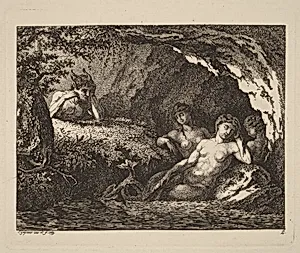
Three Sleeping Sprites with a Satyr
1769
Medium
etching on laid paper
Dimensions
plate: 11.6 x 14.4 cm (4 9/16 x 5 11/16 in.) sheet: 27.8 x 38.4 cm (10 15/16 x 15 1/8 in.)
Classification
Department
CG-E
Museum
National Gallery of Art, Washington, D.C.
Credit
Ailsa Mellon Bruce Fund
Accession Number
1999.100.6
Rights
Public Domain
Art Historical Context
Salomon Gessner’s 1769 etching *Three Sleeping Sprites with a Satyr* captures a tranquil moment from classical mythology rendered in delicate lines on laid paper. Gessner, a Swiss artist and writer celebrated for his pastoral scenes, often blended Arcadian landscapes with figures from ancient legend. Created during the late Rococo period, the print reflects the eighteenth-century taste for idyllic, dreamlike subjects that offered viewers a gentle escape into nature and fantasy. The small plate size—just under five by six inches—invites intimate viewing, allowing the fine etched details of the sleeping sprites and watchful satyr to emerge gradually. Etching, a technique prized for its ability to convey soft textures and subtle shading, was especially well suited to Gessner’s light touch and poetic sensibility. Housed in the National Gallery of Art’s collection through the Ailsa Mellon Bruce Fund, the work exemplifies how prints helped spread these charming mythological visions across Europe, bringing classical themes into private homes and personal albums.
About the Artist
Salomon Gessner · 1730–1788
Salomon Gessner was born in Zurich in 1730 into a family of printers and publishers, an upbringing that placed books, images, and ideas at the center of his world from an early age. Though largely self-taught as a visual artist, he received some instruction during a period in Berlin, where he encountered the German Rococo tradition, and his mature work reflects a deep absorption in the pastoral li...