
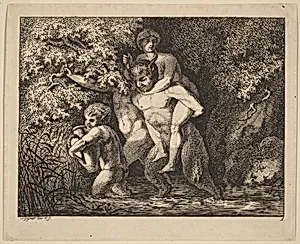
Satyr Carrying a Nymph
1769/1771
Medium
etching on laid paper
Dimensions
plate: 11.7 x 14.4 cm (4 5/8 x 5 11/16 in.) sheet: 12 x 14.7 cm (4 3/4 x 5 13/16 in.)
Classification
Department
CG-E
Museum
National Gallery of Art, Washington, D.C.
Credit
Gift of John O'Brien
Accession Number
1994.3.4
Rights
Public Domain
Art Historical Context
Created around 1769–1771, *Satyr Carrying a Nymph* showcases Salomon Gessner’s delicate etching technique on laid paper. A Swiss artist, poet, and publisher celebrated for his pastoral and mythological scenes, Gessner worked during the late Rococo period. His small-scale prints often captured idyllic visions of nature infused with classical themes, reflecting Enlightenment interests in harmony between humans and the natural world. The subject draws from ancient mythology, depicting a satyr—a half-human, half-goat figure—gently bearing a nymph through a wooded landscape. Such imagery evokes playful yet sensual encounters common in 18th-century interpretations of Arcadian life. Etching allowed Gessner to achieve fine, expressive lines that convey both movement and texture, making the medium ideal for intimate, collectible works meant for private enjoyment rather than grand public display. Measuring just under five by six inches, this print exemplifies Gessner’s skill at distilling mythological narrative into charming, accessible formats. Now part of the National Gallery of Art’s collection through the generosity of John O’Brien, it invites viewers to appreciate the refined artistry and cultural nostalgia of the era.
About the Artist
Salomon Gessner · 1730–1788
Salomon Gessner was born in Zurich in 1730 into a family of printers and publishers, an upbringing that placed books, images, and ideas at the center of his world from an early age. Though largely self-taught as a visual artist, he received some instruction during a period in Berlin, where he encountered the German Rococo tradition, and his mature work reflects a deep absorption in the pastoral li...