
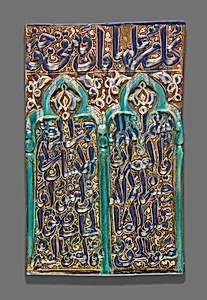
Tile with a Double-Arched Prayer Niche (Mihrab)
Ilkhanid dynasty (1256–1353), 13th century
Medium
Lusterware, fritware with molded decoration and in-glaze painting in cobalt blue and turquoise, and overglaze painting in luster
Dimensions
50.8 × 32.5 × 3.4 cm (20 × 12 3/4 × 1 3/8 in.)
Classification
earthenware
Department
Arts of Asia
Museum
Art Institute of Chicago
Accession Number
72855
Rights
Public Domain
About this artwork
This luster tile is carefully decorated with dark blue calligraphy above and below the arches, as well as a cruder, luster-painted passage following the line of the arches. The inscriptions, all taken from different chapters in the Qur'an, discuss the transience of life on earth in contrast to the eternal existence of God. The religious nature of these inscriptions is appropriate for the tile's placement in a mosque, where it would have been used as a mihrab, or prayer niche, indicating the dire...
About the Artist
Islamic
Islamic art, a profound visual tradition originating in the 7th century CE, flourished across vast territories from Spain to India under Muslim rule, encompassing architecture, ceramics, manuscripts, textiles, and metalwork produced by diverse artisans rather than a single named master. Drawing from pre-Islamic Sasanian, Byzantine, and late antique influences, its early development under the Umayy...