
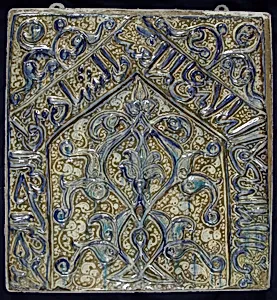
Tile with Niche Design and Inscription
Unknown Artist
early 14th century
Medium
Stonepaste; inglaze painted in blue, luster-painted on opaque white glaze, modeled decoration
Dimensions
H. 19 3/4 in. (50.4 cm) W. 18 3/4 in. (47.6 cm) D. 3 in. (7.6 cm) without mount: H. 19 in. (48.3 cm) W. 18 in. (45.7 cm) Wt. 61 lbs (27.7 kg)
Classification
Ceramics-Tiles
Department
Islamic Art
Museum
Metropolitan Museum of Art, New York, NY
Credit
H.O. Havemeyer Collection, Gift of Horace Havemeyer, 1940
Accession Number
40.181.4
Rights
Public Domain
Art Historical Context
This stunning tile, featuring a niche design and inscription, hails from the early 14th century and exemplifies the pinnacle of Islamic ceramic artistry. Crafted in stonepaste—a composite body of quartz, clay, and frit that mimicked porcelain's translucency—the tile depicts a recessed architectural niche, likely evoking the mihrab of a mosque or a luxurious palace interior. The modeled decoration adds three-dimensional depth, while intricate blue underglaze painting contrasts beautifully against an opaque white glaze, finished with shimmering luster accents that catch the light like gold. Produced during a golden age of Islamic tilework in regions like Syria or Egypt under Mamluk patronage, such pieces adorned the walls of mosques, madrasas, and elite homes. The luster technique, revived from Abbasid innovations, required masterful control of firing in smoky reduction atmospheres to achieve its metallic sheen, symbolizing opulence and spiritual radiance. Inscriptions, often Quranic verses or benedictions, invited contemplation and blessing. Measuring nearly 20 by 19 inches and weighing a hefty 61 pounds, this tile's robust scale hints at its role in grand architectural ensembles. A gift from the H.O. Havemeyer Collection to The Metropolitan Museum of Art in 0, it invites visitors to marvel at the enduring brilliance of medieval Islamic craftsmanship.