
Tiles
Unknown Artist
second half 16th century
Medium
Stonepaste; painted and glazed
Dimensions
H. 4 1/2 in. (11.4 cm) L. 16 1/2 in. (41.9 cm)
Classification
Ceramics-Tiles
Department
Islamic Art
Museum
Metropolitan Museum of Art, New York, NY
Credit
Edward C. Moore Collection, Bequest of Edward C. Moore, 1891
Accession Number
91.1.108a–c
Rights
Public Domain
Tags
Art Historical Context
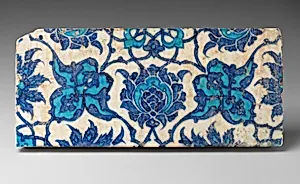
These exquisite *Tiles*, crafted by an unknown artist in the second half the 16th century exemplify the refined artistry of Islamic ceramics. Made from stonepaste—a composite material of quartz, clay, and frit that provided a durable, porcelain-like white body—these rectangular panels (4½ × 16½ inches) were painted with vibrant colors and glazed for a luminous finish. Floral motifs, a hallmark tag of this piece, bloom across their surface, evoking the lush gardens celebrated in Islamic culture. Produced during a golden age of tile-making in the Islamic world, likely in regions like Persia, Syria, or the Ottoman Empire, these tiles served both decorative and architectural purposes. Stonepaste technology, perfected by Islamic potters from the 12th century onward, allowed for intricate designs that resisted fading and were ideal for adorning mosques, palaces, and madrasas. The painted and glazed technique ensured vivid blues, greens, and golds endured, transforming interiors into paradises on earth. Today, housed in the Metropolitan Museum of Art's Islamic Art Department as part of the Edward C. Moore Collection (bequeathed in 1891), these tiles offer a window into the era's mastery of form and color. They remind us how everyday materials became vessels for beauty and spirituality in Islamic design.