
Tivoli
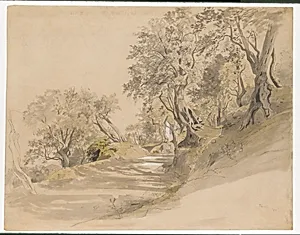
Medium
Pen, black ink, washes, and graphite on beige paper
Dimensions
18 1/2 x 23 11/16 in. (47 x 60.2 cm)
Classification
Drawing
Culture
American
Department
The American Wing
Museum
Metropolitan Museum of Art, New York, NY
Credit
Gift of Mrs. Roger Plowden, 1967
Accession Number
67.173.3
Rights
Public Domain
Tags
Art Historical Context
William Stanley Haseltine’s *Tivoli* (1858) captures the lush, dramatic landscapes of Tivoli, Italy—a site renowned for its ancient ruins, cascading waterfalls, and verdant gardens that inspired countless 19th-century artists. an American painter associated with the Luminist movement, Haseltine specialized in precise, light-infused depictions of nature, often drawing from his European travels. This work reflects his fascination with Italy’s Mediterranean scenery, rendered during a period when American artists sought inspiration abroad to refine their skills amid the Romantic emphasis on sublime wilderness. Executed in pen, black ink, washes, and graphite on beige paper, the drawing showcases Haseltine’s masterful command of mixed media. The fluid washes evoke atmospheric depth and luminosity, while fine pen lines and graphite details delineate trees and terrain with topographical accuracy—a hallmark of his style. Measuring 18½ × 23⅝ inches, it likely served as a study for larger oil paintings, highlighting the preparatory role of such works in 19th-century landscape art. Housed in The Metropolitan Museum of Art’s American Wing as a gift from Mrs. Roger Plowden in 1967, *Tivoli* exemplifies the transatlantic exchange of artistic ideas in mid-19th-century America, bridging Hudson River School traditions with European grandeur. Visitors will appreciate its intimate scale and evocative power, inviting a closer look at nature’s intricate beauty.
About the Artist
William Stanley Haseltine · 1835–1900
Comment on works: Landscapes