
Tobias and the Angel
17th century
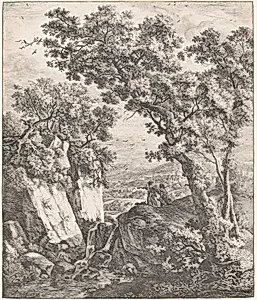
Medium
Etching; second state
Dimensions
sheet: 11 9/16 x 9 13/16 in. (29.4 x 25 cm)
Classification
Prints
Department
Drawings and Prints
Museum
Metropolitan Museum of Art, New York, NY
Credit
The Elisha Whittelsey Collection, The Elisha Whittelsey Fund, 1960
Accession Number
60.621.67
Rights
Public Domain
Tags
Art Historical Context
Anthonie Waterloo’s *Tobias and the Angel* captures a beloved biblical episode in which the young Tobias, guided by the archangel Raphael, journeys through a wooded landscape. Created in the seventeenth century during the Dutch Golden Age, the etching reflects the period’s fascination with both religious narrative and the natural world. Waterloo, a prolific etcher of landscapes, places the small figures within a richly detailed forest, inviting viewers to explore the scene as if walking alongside them. The medium of etching allowed Waterloo to achieve delicate lines and tonal contrasts that bring the towering trees and dappled light to life. This second-state impression shows the artist’s careful refinement of the composition, emphasizing the intricate foliage that dominates the sheet. At roughly 11 ½ by 9 ¾ inches, the print balances intimate scale with expansive depth, a hallmark of Dutch landscape prints meant for private collectors and connoisseurs. Acquired by the Metropolitan Museum through the Elisha Whittelsey Fund, the work exemplifies how seventeenth-century Dutch artists merged spiritual stories with the celebration of nature’s beauty. The prominent trees not only frame the narrative but also underscore the era’s growing appreciation for the countryside as a source of wonder and reflection.
About the Artist
Anthonie Waterloo · 1609–1690
Anthonie Waterloo (1609–1690) was a prominent Dutch Golden Age landscape artist, born on May 6 in Lille, then part of the Spanish Netherlands. Little is known of his early life beyond his mother, Magdalena Vaillant, who joined Amsterdam's Walloon Church in 1621, with Waterloo following in 1630; no records exist of formal training, and he was likely self-taught. Registered as a painter in Amsterdam...