
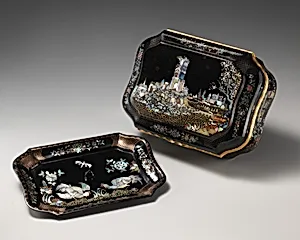
Toilet Box
ca. 1760
Medium
Lacquered metal inlaid with mother-of-pearl, copper, brass, ray skin, colored stone, gold
Dimensions
2 1/4 × 6 × 4 3/4 in. (5.7 × 15.2 × 12.1 cm)
Classification
Natural Substances
Culture
German, Dresden
Department
European Sculpture and Decorative Arts
Museum
Metropolitan Museum of Art, New York, NY
Credit
Bequest of Mrs. Charles Wrightsman, 2019
Accession Number
2019.283.106a–c
Rights
Public Domain
Art Historical Context
Crafted around 1760 by Johann Martin Heinrici, a master artisan from Dresden, Germany, this exquisite *Toilet Box* served as a luxurious vanity case for the elite, holding cosmetics, jewelry, or personal grooming items. Measuring just 2¼ × 6 × 4¾ inches, its compact belies the opulence within, reflecting the Rococo era's love for intricate, playful luxury. Dresden, under Saxon court patronage, was a hub for such decorative arts, rivaling Meissen porcelain in finesse. Heinrici's virtuosity shines in the mixed-media construction: lacquered metal forms the base, inlaid with shimmering mother-of-pearl, copper, brass, ray skin (shagreen for texture), colored stones, and gold. This technique emulated prized Asian lacquerware—popular in Europe via trade—while showcasing European ingenuity in *Vernis Martin* japanning and precise inlay work. The result is a jewel-like object, where light dances across surfaces, blending natural substances with metals for tactile and visual delight. Housed in The Metropolitan Museum of Art's European Sculpture and Decorative Arts collection (Bequest of Mrs. Charles Wrightsman, 2019), this piece highlights 18th-century German craftsmanship's peak, embodying status and refinement for aristocratic toilette rituals. A true miniature masterpiece!
About the Artist
Johann Martin Heinrici · 1711–1786
**Johann Martin Heinrici (1711–1786)** was a German porcelain painter, miniaturist, and engraver renowned for his exquisite decorative work on luxury objects and porcelain during the mid-eighteenth century. Born in Lindau in 1711, he became one of the leading figures in the specialized field of porcelain decoration and lacquerwork techniques adapted for European tastes. Heinrici trained and worke...