
Tongue River Cliffs (In Camp)
1892
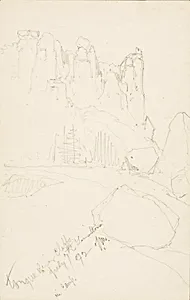
Medium
Drawing
Classification
Drawing
Department
Smithsonian Collection
Museum
Smithsonian American Art Museum
Credit
Smithsonian American Art Museum, Gift of Dr. William Henry Holmes
Accession Number
1947.13.4
Rights
Public Domain
Tags
Art Historical Context
Step into the rugged embrace of Wyoming's Rocky Mountains with Thomas Moran's *Tongue River Cliffs (In)*, a captivating 1892 drawing from Smithsonian American Art Museum. during Moran's lifelong passion for the American West, this work captures a serene campsite nestled against dramatic cliffs along the Tongue River. The scene evokes the quiet majesty of the frontier, blending natural grandeur with the intimacy of human presence amid towering rock faces and winding waters. Moran, a master of the Hudson River School luminist traditions, was renowned for his vivid depictions of unspoiled landscapes that helped fuel America's conservation movement—most famously through his Yellowstone sketches that swayed Congress to establish the first national park. This drawing, likely made en plein air during one of his expeditions, showcases his keen eye for light, texture, and scale, using precise lines to convey the cliffs' imposing forms and the river's gentle flow. As a preparatory sketch in drawing medium, it highlights Moran's technique of on-site observation, preserving fleeting moments of wilderness exploration. Gifted to the Smithsonian by Dr. William Henry Holmes, a fellow artist and geologist, the piece underscores the era's scientific-artistic synergy in documenting the vanishing West. A window into 19th-century adventure, it invites us to ponder our enduring bond with these timeless landscapes.
About the Artist
Thomas Moran · 1837–1926
Thomas Moran (1837–1926) was an American painter and printmaker of the Hudson River School whose dramatic paintings of the American West played a pivotal role in the creation of the national parks. Born in Bolton, Lancashire, England, he emigrated with his family to Philadelphia as a child. He was largely self-taught, though he apprenticed briefly with a wood engraver and studied the work of J.M.W...