
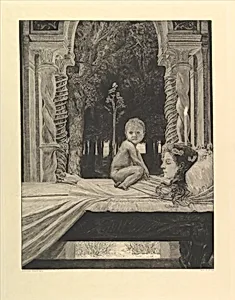
Tote Mutter, from the series Vom Tode Zweiter Teil
n.d.
Medium
Etching and aquatint
Dimensions
Plate: 17 15/16 × 13 3/4 in. (45.6 × 35 cm) Sheet: 21 15/16 × 15 7/8 in. (55.7 × 40.4 cm)
Classification
Prints
Department
Drawings and Prints
Museum
Metropolitan Museum of Art, New York, NY
Credit
Gift of Dr. F. H. Hirschland, 1952
Accession Number
52.586.2(10)
Rights
Public Domain
Tags
Art Historical Context
**Tote Mutter (Dead Mother), from the *Vom Tode Zweiter Teil *Max Klinger, n.d. Etching and aquatint Metropolitan Museum of Art* Klinger, a pioneering German Symbolist artist (18571920), created this haunting print as part of his ambitious series *Vom T Zweiter Teil* (" Death, Second Part"), profound themes of mortality, loss, and the human condition. Active in the late 19th and early 20th centuries, Klinger blended Romantic fantasy with emerging modernist sensibilities, influencing movements like Jugendstil (German Art Nouveau). "Tote Mutter" poignantly captures the tragedy of a lifeless mother amid children, evoking universal grief through its stark tags of death, women, and children—a motif that resonated in an era grappling with industrialization's harsh realities and personal fragility. Klinger's mastery shines in his use of etching and aquatint, techniques that yield exquisite detail and tonal depth. Etching allows precise, expressive lines for intricate figures and drapery, while aquatint adds velvety shadows and atmospheric mood, mimicking painting's richness on paper. At nearly 18 by 14 inches on the plate, the work's scale amplifies its emotional intensity, drawing viewers into a dreamlike yet visceral narrative. This gift to the Met in 1952 preserves Klinger's legacy as a printmaker who elevated graphic art to philosophical heights, inviting reflection on life's impermanence. A must-see for those fascinated by Symbolism's emotional depth. (198 words)
About the Artist
Max Klinger · 1857–1920
Max Klinger, born on February 18, 1857, in Leipzig to a wealthy family, emerged as one of Germany's most innovative artists across painting, sculpture, printmaking, and graphics. Demonstrating early talent, he enrolled at the Academy of Fine Arts in Karlsruhe in 1874 as a pupil of Karl Gussow, following his teacher to the Berlin Academy upon Gussow's appointment as director, and graduated in 1877 ...