
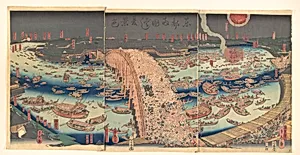
Tōtō Ryōgokubashi natsu keshiki|Panoramic View of Ryōgoku Bridge in the Summer
19th century
Medium
Triptych of woodblock prints; ink and color on paper
Dimensions
Image (a): 13 3/4 x 9 1/2 in. (34.9 x 24.1 cm) Image (b): 13 3/4 x 9 1/2 in. (34.9 x 24.1 cm) Image (c): 14 x 9 1/2 in. (35.6 x 24.1 cm)
Classification
Prints
Culture & Period
Japan · Edo period (1615–1868)
Department
Asian Art
Museum
Metropolitan Museum of Art, New York, NY
Credit
Bequest of William S. Lieberman, 2005
Accession Number
2007.49.294a–c
Rights
Public Domain
Tags
Art Historical Context
This vibrant triptych by Utagawa Sadahide captures the lively summer atmosphere along Tokyo’s Sumida River at Ryōgoku Bridge during Japan’s late Edo period. Created in the 19th century as a set of three woodblock prints, the panoramic composition invites viewers to experience the bustling scene of crowds gathering on the bridge, pleasure boats gliding below, and seasonal festivities unfolding along the water’s edge. Sadahide, a member of the renowned Utagawa school, specialized in such dynamic urban views that celebrated the everyday pleasures of Edo life. Woodblock printing, the medium used here, allowed artists to produce affordable, colorful images that reached a wide audience. The technique’s bold lines and layered pigments bring energy to the composition, highlighting the contrast between the solid bridge structure and the flowing river activity. As part of the ukiyo-e tradition, these prints preserved fleeting moments of urban culture just before Japan’s rapid modernization. Today, the work offers a vivid glimpse into 19th-century Japanese society, where public spaces like Ryōgoku Bridge served as stages for communal enjoyment and seasonal celebrations.
About the Artist
Utagawa (Gountei) Sadahide · 1807–1873
Utagawa Sadahide was born Hashimoto Kenjirō in 1807 in Fusa Province, in the area of modern Chiba Prefecture, Japan. In the 1820s he entered the studio of the enormously prolific and influential master Utagawa Kunisada, becoming one of Kunisada's most prominent pupils and adopting the studio name Sadahide along with the Utagawa school's celebrated lineage. By 1828 his name appeared on a monument l...