
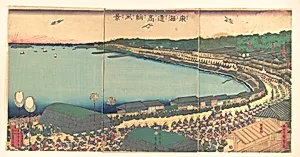
Daimyo's Processions Passing along the Tōkaidō
19th century
Medium
Triptych of woodblock prints; ink and color on paper
Dimensions
Image (d): 14 3/8 x 9 3/4 in. (36.5 x 24.8 cm) Image (e): 14 1/2 x 9 5/8 in. (36.8 x 24.4 cm) Image (f): 14 3/8 x 9 1/2 in. (36.5 x 24.1 cm)
Classification
Prints
Culture & Period
Japan · Edo period (1615–1868)
Department
Asian Art
Museum
Metropolitan Museum of Art, New York, NY
Credit
Bequest of William S. Lieberman, 2005
Accession Number
2007.49.291a–c
Rights
Public Domain
Tags
Art Historical Context
Behold the grandeur of feudal Japan in *Daimyo's Processions along the Tōkaō*, a stunning triptych woodblock print Utagawa (Gountei) Sadahide the 19th century This Edo-period masterpiece (1615–1868), with vibrant ink and color on paper unfolds across three panels—measuring about 14½ x 29½ inches when combined—capturing a panoramic procession of a daimyo, or feudal lord, and his retinue. Sadahide, a prolific artist from the renowned Utagawa school, mastered ukiyo-e techniques, layering fine woodblock impressions to evoke the "floating world" of everyday spectacle and hierarchy. The Tōkaidō, one of Japan's historic post roads linking Edo (modern Tokyo) to Kyoto, was the stage for these mandated journeys under the sankin kōtai system. Daimyo traveled in elaborate convoys—complete with samurai, porters, and banners—to affirm loyalty to the shogun, their processions a dazzling display of status and power that captivated onlookers. Sadahide's print immortalizes this ritual, blending meticulous detail in clothing, weapons, and landscapes with dynamic composition to convey motion and scale. Housed in the Metropolitan Museum of Art's Asian Art department (Bequest of William S. Lieberman, 2005), this work highlights ukiyo-e's role in democratizing elite scenes through affordable prints. Visitors, imagine the clatter of geta sandals and rustle of silk— a vivid window into Japan's harmonious yet stratified society.
About the Artist
Utagawa (Gountei) Sadahide · 1807–1873
Utagawa Sadahide was born Hashimoto Kenjirō in 1807 in Fusa Province, in the area of modern Chiba Prefecture, Japan. In the 1820s he entered the studio of the enormously prolific and influential master Utagawa Kunisada, becoming one of Kunisada's most prominent pupils and adopting the studio name Sadahide along with the Utagawa school's celebrated lineage. By 1828 his name appeared on a monument l...