
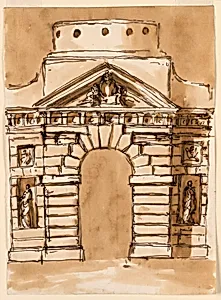
Town gate
1780–1790
Classification
architecture
Department
Smithsonian Collection
Museum
Smithsonian American Art Museum
Credit
Museum purchase through gift of various donors and from Eleanor G. Hewitt Fund
Accession Number
1938-88-1716
Rights
Public Domain
About this artwork
Research in Progress
Art Historical Context
Step into the architectural imagination of late 18th-century Italy *Town Gate*, a compelling design by Giuseppe Barberi1746–1809). Created between 1780 and 1790, this work captures the era's fascination with grand urban gateways—symbols of civic pride, defense, and classical revival. Barberi, a architect active during the Enlightenment, contributed to the neoclassical movement, blending ancient Roman forms with contemporary functionality. As part of the Smithsonian American Art's collection (purchased through gifts from various donors and the Eleanor G. Hewitt Fund), *Town Gate* exemplifies how architectural drawings or models served as blueprints for real-world structures. Though the exact medium remains under study—research is ongoing—this piece highlights Italy's enduring influence on American collections, bridging European design traditions with global appreciation. Imagine the bustling town square it evokes: sturdy arches framing passageways, ornate details nodding to antiquity. Barberi's vision invites us to ponder how gates defined communities, marking transitions from the everyday to the monumental. A testament to evolving scholarship, it reminds visitors of art history's living dialogue.