
Travellers in Cold Mountains
1859
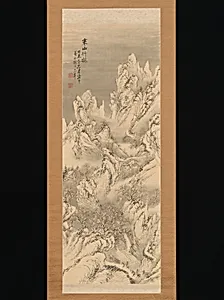
Medium
Hanging scroll; ink and color on silk
Dimensions
Image: 53 15/16 × 20 3/16 in. (137 × 51.3 cm) Overall with mounting: 88 × 26 11/16 in. (223.5 × 67.8 cm) Overall with knobs: 88 × 30 1/2 in. (223.5 × 77.5 cm)
Classification
Paintings
Culture & Period
Japan · Edo period (1615–1868)
Department
Asian Art
Museum
Metropolitan Museum of Art, New York, NY
Credit
Mary Griggs Burke Collection, Gift of the Mary and Jackson Burke Foundation, 2015
Accession Number
2015.300.196
Rights
Public Domain
Tags
Art Historical Context
**Travellers in Cold Mountains (1859) by Hine Taizan is a hanging scroll painted in ink and color on silk, exemplifying the refined literati tradition of late Edo-period Japan (1615–1868). nearly 54 inches tall, this vertical composition invites viewers into a vast, snow-dusted mountainscape where tiny human figures—solitary travelers bundled against the chill—traverse precarious paths. Taizan, a master of the *nanga* (Southern) style influenced by Chinese scholar-artists, skillfully blends delicate washes of mineral pigments with bold ink strokes to evoke the sublime power of nature. Hanging scrolls like this were prized in Japanese homes and temples, unrolled seasonally in alcove displays (*tokonoma*) to inspire contemplation and harmony with the seasons. The wintry theme, with its stark whites and muted blues, reflects *mono no aware*—a poignant awareness of life's transience—common in Edo landscapes. Taizan's technique, layering translucent colors over ink outlines, creates atmospheric depth, making distant peaks shimmer ethereally. From the Mary Griggs Burke Collection at The Metropolitan Museum of Art, this work highlights Japan's cultural synthesis of Zen minimalism and imported Chinese aesthetics, offering visitors a serene window into 19th-century wanderlust and resilience amid nature's grandeur.