
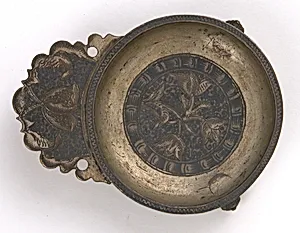
Tray
Unknown Artist
18th century
Medium
Brass (or silver-gilt?), niello
Dimensions
H. 15/16 in. (2.4 cm) W. 3 9/16 in. (9 cm) D. 2 5/8 in. (6.7 cm) Wt. 2.1 oz. (59.5 g)
Classification
Metal
Department
Islamic Art
Museum
Metropolitan Museum of Art, New York, NY
Credit
Gift of Harry G. Friedman, 1963
Accession Number
63.86.1
Rights
Public Domain
Tags
Art Historical Context
This exquisite 18th-century tray from the Islamic world exemplifies the refined metalworking traditions of the period. Crafted from brass—possibly silver-gilt—and adorned with niello, a sophisticated technique where a black metallic alloy is inlaid into incised designs for striking contrast, the tray measures just 3 9/16 inches wide. Its petite dimensions (H. 15/16 in., D. 2 5/8 in.) and lightweight 2.1 oz. form suggest it was designed for intimate use, perhaps serving sweets, spices, or betel nuts during social gatherings. Floral motifs, a hallmark of Islamic decorative arts, likely grace its surface, evoking the paradisiacal gardens celebrated in Islamic poetry and scripture. Niello's glossy black against the gleaming metal creates a jewel-like effect, blending functionality with artistry. Produced in an era of Ottoman, Safavid, or Mughal influence, such trays highlight the era's mastery of damascening and inlay, techniques that spread across Eurasia via trade routes. A gift to the Metropolitan Museum of Art from Harry G. Friedman in 1963, this anonymous masterpiece invites visitors to appreciate the subtle elegance of Islamic metalwork, where everyday objects became canvases for spiritual and aesthetic beauty.