
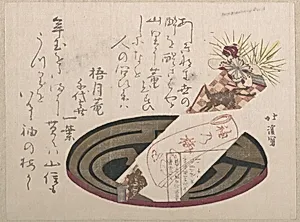
Tray with Noshi Paper (Noshi Indicates a Present)
1816
Medium
Part of an album of woodblock prints (surimono); ink and color on paper
Dimensions
5 11/16 x 7 1/2 in. (14.4 x 19.1 cm)
Classification
Prints
Culture & Period
Japan · Edo period (1615–1868)
Department
Asian Art
Museum
Metropolitan Museum of Art, New York, NY
Credit
H. O. Havemeyer Collection, Bequest of Mrs. H. O. Havemeyer, 1929
Accession Number
JP2288
Rights
Public Domain
Tags
Art Historical Context
In the vibrant world of Edo-period Japan (1615–1868), Totoya Hokkei, a pupil of the famed Utagawa school, this delicate woodblock print in 1816. Titled *Tray with Noshi PaperNoshi Indicates a Present, it is part of a luxurious surimono album—a genre of privately commissioned prints often as New Year's greetings or gifts among poets, artists, and elites. Measuring just 5 11/16 x 7 1/2 inches, its intimate scale invites close admiration, revealing intricate details of a tray adorned with flowers and the distinctive noshi paper, a ceremonial decoration symbolizing good fortune and celebration. Surimono like this one elevated woodblock printing beyond mass-produced ukiyo-e, employing premium inks, subtle colors, and sometimes embossing or mica for a tactile, shimmering effect. Noshi, derived from dried abalone strips attached to gifts, signified respect and abundance in Japanese culture, transforming everyday objects into emblems of social harmony and seasonal joy. Hokkei's precise lines and harmonious composition capture this ephemeral elegance, blending everyday still life with poetic refinement. Housed in the Metropolitan Museum of Art's Asian Art Department from the H. O. Havemeyer Collection, this print offers a window into Japan's refined printmaking tradition, where art intertwined with etiquette and festivity. Visitors will appreciate its quiet beauty, a testament to Edo Japan's artistic ingenuity.
About the Artist
Totoya Hokkei · 1780–1850
Totoya Hokkei (魚屋 北渓, 1780–1850), born Iwakubo Tatsuyuki in Edo (modern Tokyo), began his life as a humble fishmonger in the Yotsuya Samegahashi district, a trade reflected in his art name "Totoya," meaning fish shop. He transitioned to art through rigorous training, first studying under Kanō Yōsen'in Korenobu, head of the Kobikichō branch of the prestigious Kanō school, where he honed landscape p...