
Triangular-shaped Tweezers
Probably 1000–1400
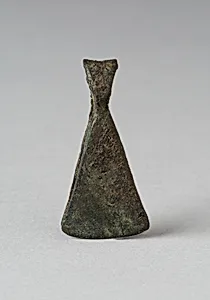
Medium
Copper alloy
Dimensions
H.: 4.5 cm (1 3/4 in.)
Classification
metal
Department
Arts of the Americas
Museum
Art Institute of Chicago
Accession Number
91942
Rights
Public Domain
Art Historical Context
Nestled in the Arts of the Americas collection at the Art Institute of Chicago these *Triangular-shaped Tweezers* hail from the Chimú culture of ancient Peru, dating to around 1000–1400 CE. The Chimú, who flourished along Peru's northern coast before their conquest by the Inca in the late 15th century, were master builders of vast adobe cities like Chan Chan renowned for their sophisticated metallurgy. This small yet exquisite tool, standing just 4.5 cm tall, exemplifies their everyday artistry amid a thriving pre-Columbian society. Crafted from copper alloy—a durable material the Chimú hammered and shaped with precision—the tweezers feature a distinctive triangular form that suggests both functionality and aesthetic refinement. Likely used for personal grooming, such as removing facial or body hair, or perhaps in ritualistic practices, these implements highlight the culture's advanced metalworking techniques. Copper alloys allowed for lightweight, resilient objects that could be intricately tooled, blending utility with subtle elegance. Beyond their practical role, Chimú metalwork like this reflects a worldview where craftsmanship honored the divine and communal life. Though modest in scale, these tweezers offer a tangible glimpse into the ingenuity of a civilization whose legacy endures in Peru's archaeological treasures, inviting us to appreciate the artistry in the ancient ordinary.
About the Artist
Chimú
The Chimú, a preeminent pre-Columbian culture of Peru's northern coast, flourished from approximately 900 to 1470 CE as the Kingdom of Chimor, emerging in the wake of the Moche civilization's decline and incorporating influences from the Sican, Wari, and Cajamarca cultures. Centered in the vast adobe metropolis of Chan Chan—the largest city in the Americas before the Inca, housing up to 60,000 peo...