
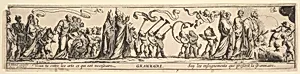
Triumph of Grammar
17th century
Medium
Etching
Dimensions
Sheet: 3 x 13 1/16 in. (7.6 x 33.2cm)
Classification
Prints
Department
Drawings and Prints
Museum
Metropolitan Museum of Art, New York, NY
Credit
The Elisha Whittelsey Collection, The Elisha Whittelsey Fund, 1960
Accession Number
60.551.3
Rights
Public Domain
Tags
Art Historical Context
**Triumph of Grammar is a delicate 17th-century etching French artist Pierre Brébiette, a master of Mannerist style known for his intricate line work and allegorical scenes. Created during the reign of Louis XIII, this print captures the exuberant theme of Grammar's triumph—a classical motif celebrating the liberal arts through personified figures. Measuring just 3 x 131/16 inches, its elongated format suggests a frieze-like composition, ideal etching's precision in rendering fine details. The artwork features men and women amid musical instruments, evoking a festive procession where Grammar reigns supreme, symbolizing the Renaissance revival of humanist education. Etching, Brébiette's favored medium, allowed artists like him to produce affordable, reproducible images that popularized erudite themes among Europe's growing print-buying public. This technique's bitten lines create rich tonal contrasts, bringing the lively gathering to life on a small scale. Housed in the Metropolitan Museum of Art's Drawings and Prints department as part of The Elisha Whittelsey Collection (acquired 1960), it exemplifies the era's fusion of scholarship and spectacle. Visitors will appreciate its whimsical nod to learning's joys, a reminder of art's role in immortalizing intellectual pursuits.
About the Artist
Pierre Brebiette · 1598–1642
Pierre Brébiette (c. 1598–c. 1642) was a French painter and etcher whose elegant, sensuous treatment of classical mythology and allegory earned him a significant reputation in early seventeenth-century Paris. Born in Mantes-sur-Seine, Brébiette traveled to Italy as a young man and lived and worked in Rome from around 1617 to approximately 1625, absorbing the influences of ancient sculpture, Renais...