
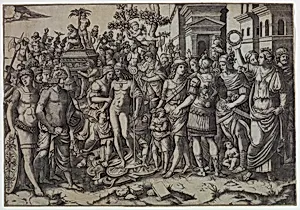
Triumph of Titus
Classification
Department
Smithsonian Collection
Museum
Smithsonian American Art Museum
Credit
Bequest of George Campbell Cooper
Accession Number
1896-3-57
Rights
Public Domain
About this artwork
Research in Progress
Art Historical Context
Behold the *Triumph of Titus a captivating print by Marcantonio Raimondi (c. 1483–1527), one of the Renaissance's greatest engravers, created around 1520. This work, now housed in the Smithsonian American Museum through the bequest of George Campbell Cooper captures the victorious procession of the Roman emperor Titus, celebrating his conquest of Jerusalem in 70 CE. Raimondi's precise engraving technique—hallmarks of his mastery—brings the ancient spectacle to life, evoking the pageantry of imperial Rome with chariots, spoils, and adoring crowds. As a key figure in High Renaissance printmaking, Raimondi collaborated closely with Raphael, translating grand designs into widely disseminated engravings. This print exemplifies how such innovations democratized art, allowing collectors across Europe to own replicas of monumental visions inspired by classical antiquity. During the early 16th century, renewed fascination with Roman history fueled the Renaissance revival of triumphal motifs, symbolizing power, victory, and divine favor. Though research continues on this piece, *Triumph of Titus* stands as a testament to engraving's role in preserving and propagating cultural heritage, bridging ancient glory with modern artistry. A true gem for admirers of history and technique alike.