
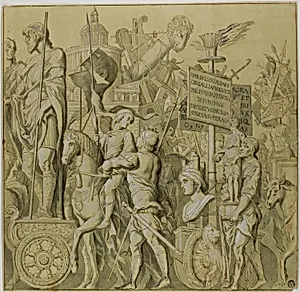
Triumphs of Julius Caesar: Canvas No. II
18th century
Medium
Pen and brown ink, with brush and gray wash, heightened with lead white (oxidized), on cream laid paper prepared with yellow wash
Dimensions
37.2 × 38 cm (14 11/16 × 15 in.)
Classification
pen and ink drawings
Department
Prints and Drawings
Museum
Art Institute of Chicago
Accession Number
95689
Rights
Public Domain
Art Historical Context
Andrea Mantegna's *Triumphs of Julius: Canvas No. II* is a captivating drawing that evokes the grandeur of ancient Rome, part of the renowned Renaissance series celebrating Julius Caesar's military victories. Created in the 18th century—likely a meticulous study or copy after Mantegna's late-15th-century tempera paintings—this work reflects the artist's profound influence on generations of draughtsmen. Mantegna, a pioneer of the Early Renaissance in northern Italy, drew inspiration from classical texts like Plutarch to depict triumphal processions, blending historical narrative with innovative perspective and antique motifs. Executed in pen and brown ink with brush and gray wash, heightened with oxidized lead white on cream laid paper prepared with yellow wash, the drawing measures a modest 37.2 × 38 cm. These techniques create dramatic chiaroscuro effects and luminous highlights, mimicking the sculptural quality of Roman reliefs that Mantegna admired. The medium's precision allowed for intricate details of figures, armor, and spoils, underscoring the technical virtuosity of Renaissance draftsmanship. Housed in the Art Institute of Chicago's Prints and Drawings department, this piece highlights the enduring cultural fascination with Caesar's triumphs as symbols of power and imperial glory. It invites visitors to appreciate how Mantegna's vision bridged antiquity and the modern era, inspiring neoclassical revivals centuries later.
About the Artist
Andrea Mantegna · 1431–1506
Andrea Mantegna was born around 1431 near Padua, in the Venetian Republic, the son of a carpenter. At approximately age eleven he was taken into the workshop of the Paduan painter and antiquities collector Francesco Squarcione, who enrolled him as a guild member and immersed him in the study of Roman sculpture and classical Latin. Though Mantegna later claimed that Squarcione had exploited his lab...