
Trivet
c. 1938
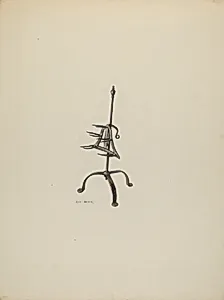
Medium
watercolor, pen and ink, and graphite on paperboard
Dimensions
overall: 50.8 x 38.3 cm (20 x 15 1/16 in.)
Classification
Index of American Design
Department
CG-W
Museum
National Gallery of Art, Washington, D.C.
Credit
Index of American Design
Accession Number
1943.8.13372
Rights
Public Domain
Art Historical Context
**Trivet**, a captivating rendering by artist Roy Weber circa 1938, showcases meticulous craftsmanship through watercolor, pen and ink, and graphite onboard. Measuring 50.8 x 38.3 cm, this work belongs to the National Gallery of's Index of American Design. Weber's piece depicts a traditional trivet—a sturdy stand for hot pots and irons—highlighting its functional beauty rooted in American folk traditions, likely from early colonial or 19th-century workshops. Created during the Great Depression as part of the Federal Art Project under the Works Progress Administration (WPA), the Index of American Design (1935–1942) employed artists like Weber to document over 18,000 everyday objects. These vibrant, precise renderings celebrated the ingenuity of American decorative arts, preserving cultural heritage amid economic hardship and fostering national pride. Weber's technique blends soft watercolor washes for texture and depth with fine pen lines and graphite for sharp details, capturing the trivets's intricate motifs—perhaps pierced designs or turned wood elements—elevating a humble household item to artistic icon. This work invites visitors to appreciate how ordinary tools embodied America's resourceful spirit.
About the Artist
Roy Weber · 1855–present
**Roy Weber** was an American artist active circa 1935, best known for his precise watercolor and graphite renderings created as part of the Index of American Design. This ambitious Works Progress Administration (WPA) project during the Great Depression sought to document and preserve America’s folk and decorative arts through detailed illustrations. Weber produced at least 22 such works, now in ...