
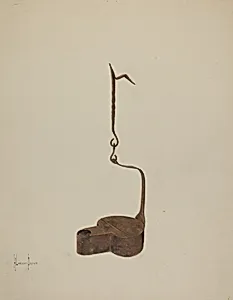
Wrought Iron Betty Lamp
c. 1937
Medium
watercolor, graphite, and pen and ink on paper
Dimensions
overall: 40.7 x 32.1 cm (16 x 12 5/8 in.) Original IAD Object: 3 3/4" long; 2 3/4" wide; 4 3/4" high
Classification
Index of American Design
Department
CG-W
Museum
National Gallery of Art, Washington, D.C.
Credit
Index of American Design
Accession Number
1943.8.12352
Rights
Public Domain
Art Historical Context
Step into the illuminating world of American folk craft with *Wrought Iron Betty Lamp*, a meticulous rendering by artist H. Langden Brown, circa 1937. Created as part of the Index of American Design—a WPA Federal Art Project during the Great Depression—this watercolor, graphite, and pen-ink drawing on paper (40.7 x 32.1 cm) captures essence of a humble yet ingenious colonial-era object. The original Betty lamp, measuring just 3 3/4 inches long, 2 3/4 inches wide, and 4 3/4 inches high, exemplifies early American ingenuity in everyday lighting. Betty lamps, named possibly after their designer Elizabeth, were popular from the 18th century onward. Crafted from durable wrought iron, these wick-fed oil lamps featured a reservoir, nozzle, and swiveling bail handle for easy hanging or carrying. Brown's artwork preserves this vanishing craft tradition, highlighting regional metalworking skills from early American workshops and their role in self-sufficient pioneer life. Through Brown's skilled layering of vibrant watercolor washes for metallic sheen, precise graphite shading for depth, and fine pen-and-ink outlines for clarity, the drawing transcends documentation to celebrate cultural heritage. Housed in the National Gallery of Art's Index of American Design collection, it reminds us how art can safeguard the quiet beauty of America's utilitarian past.
About the Artist
H. Langden Brown · 1879–1960
H. Langden Brown (1879–1960) was an American artist best known for his contributions to the Index of American Design, a Federal Art Project under the Works Progress Administration (WPA) from 1935 to 1942. This ambitious initiative commissioned artists across the United States to create meticulous watercolor renderings of everyday objects, tools, vehicles, and crafts that embodied the nation's folk...