
Trombone Player
1935–40
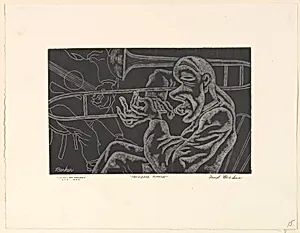
Medium
Wood engraving
Dimensions
Block: 5 x 7 3/4 in. (12.7 x 19.7 cm) Sheet: 8 3/4 x 11 1/4 in. (22.2 x 28.6 cm)
Classification
Prints
Department
Drawings and Prints
Museum
Metropolitan Museum of Art, New York, NY
Credit
Harris Brisbane Dick Fund, 1940
Accession Number
40.111.74
Rights
Public Domain
Tags
Art Historical Context
**Trombone Player** by Fred Becker, created between 1935 and 1940, captures the spirit of American life during the Great Depression era. As part of the Works Progress AdministrationWPA)—a New Deal program that artists to document everyday scenes—ecker's wood engraving highlights male musician immersed in his craft The image reflects the culturalancy of jazz and swing, popular escapes amid economic, portraying the trombon with focused intensity that resonates the working-class heroism celebrated WPA art. Wood engraving Becker's chosen medium, a meticulous relief printing technique fine lines are incised into a hard wood block (here, 5 x 3/4 inches), allowing for intricate details and bold contrasts when inked and printed on a larger sheet. This method, rooted in 19th-century traditions but revived for affordable mass production, made WPA prints accessible to the public, disseminating art beyond elite galleries. Acquired through the Harris Brisbane Dick Fund and housed in The Metropolitan Museum of Art's Drawings and Prints department, this piece exemplifies how federal initiatives preserved artistic talent and cultural narratives. Visitors today can appreciate its nod to American resilience, where a simple trombone solo symbolizes joy and perseverance in tough times.
About the Artist
Fred Becker|WPA (American| ) · 1913 | –2004 |
American, Oakland, California 1913–2004 Amherst, Massachusetts|