
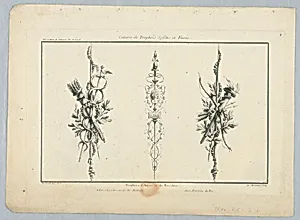
Trophies with Attributes of Love and Bacchus
ca. 1778–1782
Classification
Department
Smithsonian Collection
Museum
Smithsonian American Art Museum
Credit
Gift of Eleanor and Sarah Hewitt
Accession Number
1931-94-622
Rights
Public Domain
About this artwork
Research in Progress
Art Historical Context
In the late 18th century, French artist Richard de Lalonde crafted intricate designs for the decorative arts during the elegant Louis XVI period, a time of refined opulence just before the French Revolution. *Trophies with Attributes of Love and Bacchus*, created around 1778–1782, exemplifies his specialty in ornamental prints—likely engravings meant as models for furniture makers, silversmiths, and interior decorators. As a print from this era, it served as a practical blueprint, disseminating sophisticated motifs across workshops and influencing the neoclassical taste for symmetry and classical allusions. The title reveals a playful yet symbolic composition: "trophies" were stylized arrangements of objects, here blending emblems of Love—perhaps Cupid's bow, hearts, or doves—with those of Bacchus, the Roman god of wine, like grapevines, thyrsi, and revelry tools. This fusion evokes romantic indulgence and festive abundance, mirroring the aristocratic pursuits of pre-Revolutionary France. Housed in the Smithsonian American Art Museum as a gift from Eleanor and Sarah Hewitt, the work highlights the transatlantic appeal of French design, bridging European courts and American collectors. Though research continues, Lalonde's piece captures the era's artistic ingenuity, where everyday luxury met mythology, inviting us to imagine it adorning a grand salon or gilded frame.