
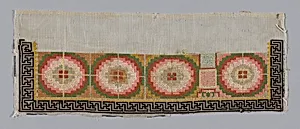
Trouser Band
Qing dynasty (1644–1911), 1875/1900
Medium
Forty-four pairs and eight odd pieces of embroidered sleeve, ankle bands, etc. on gauze.
Dimensions
13.7 × 34.1 cm (5 3/8 × 13 3/8 in.)
Classification
costume - embroidery
Department
Textiles
Museum
Art Institute of Chicago
Accession Number
156166
Rights
Public Domain
Art Historical Context
Welcome to the Textiles gallery, where we encounter the delicate artistry of "Trouser Band a captivating Qing dynasty (1644–1911) piece crafted by Han-Chinese artisans around 1875–1900. This intriguing work comprises forty-four pairs and eight individual embroidered sleeve bands, ankle bands, and elements meticulously mounted on sheer gauze. Measuring just .7 × 34.1 cm, it exemplifies the precision of late imperial Chinese costume accessories, likely adorning trousers or lower garments for both function and flair. In the era, under Manchu rule, Han-Chinese textile traditions flourished, blending everyday utility with symbolic embroidery. These bands, classified as costume embroidery, highlight advanced stitching techniques on lightweight gauze—a medium prized for its translucency and ability to showcase intricate patterns. Such pieces protected clothing hems from wear while displaying cultural motifs, reflecting the era's emphasis on harmony between practicality and aesthetic refinement. Today, at the Art Institute of Chicago, "Trouser Band" offers a window into 19th-century Chinese domestic life and sartorial elegance. Its preservation underscores the enduring legacy of embroidery as a revered craft, inviting us to appreciate the skilled hands that wove beauty into the fabric of daily existence.
About the Artist
Han-Chinese
**Han-Chinese** was the collective attribution given to anonymous artisans of Han Chinese descent who crafted intricate embroidered textiles during the Qing dynasty (1644–1911). These makers, active primarily in the late 18th to early 20th centuries, specialized in luxurious garments and furnishings that showcased the pinnacle of Han Chinese needlework traditions. Their early lives and individual ...