
Tsuba
1595–1615
Classification
metalwork
Department
Smithsonian Collection
Museum
Smithsonian American Art Museum
Credit
Bequest of George Cameron Stone
Accession Number
1936-4-30
Rights
Public Domain
About this artwork
Research in Progress
Art Historical Context
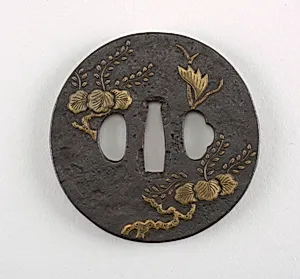
Welcome to the Smithsonian American Art Museum's showcase of exquisite Japanese metalwork. This *Tsuba*, crafted by the Heianjo-Zogan School around 1595–1615, is a masterful sword guard from Japan's late Momoyama period. Tsuba were essential components of samurai swords, protecting the hand while serving as miniature canvases for artistry. Bequeathed by George Cameron Stone, this piece exemplifies the era's blend of functionality and opulence, when swords symbolized status amid feudal Japan's shifting powers. The Heianjo-Zogan School, active in Kyoto's Heianjo district, pioneered *zogan*—a technique of inlaying gold, silver, and other metals into an iron base to create intricate designs. Often featuring floral motifs, landscapes, or mythical scenes, these tsuba reflected Zen influences and courtly elegance. This school's work marked a transition from sturdy Muromachi guards to the more decorative styles of the Edo era, highlighting metalworkers' skill in balancing delicacy with durability. Though research continues, this tsuba invites us to ponder samurai culture's artistry—where every edge told a story of honor and beauty. A true gem in the Smithsonian Collection! (198 words)