
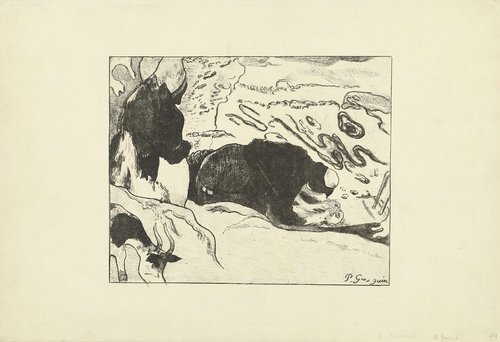
Twee wasvrouwen wassen kleding bij water
1900 - 1939
Medium
zincography
Dimensions
262; 215
Rights
Public Domain
About this artwork
height 215 mm x width 262 mm
Art Historical Context
Paul Gauguin’s “Twee wasvrouwen wassen kleding bij water” captures a quiet moment of daily life beside a body of water. Created as a zincograph—a printmaking technique that uses zinc plates to produce bold, graphic lines and rich tonal contrasts—this work reflects the artist’s interest in simplified forms and scenes drawn from ordinary routines. Measuring just 215 by 262 millimeters, the intimate scale invites close viewing and highlights the tactile quality of the printed surface. Gauguin, a leading figure of Post-Impressionism and Symbolism, often sought inspiration beyond Europe, especially during his stays in Tahiti. Although the precise setting here is not specified, the subject of washerwomen aligns with his broader fascination with women engaged in communal tasks, rendered with a sense of calm dignity and connection to nature. The zincograph medium allowed him to translate these observations into prints that could reach wider audiences while preserving the expressive contours and flattened space characteristic of his mature style. Dating from the early twentieth century, the work exemplifies Gauguin’s enduring influence on modern printmaking. Its modest dimensions and graphic clarity make it an excellent example of how he blended observed reality with a more decorative, almost timeless vision of human activity.
About the Artist
Paul Gauguin · 1848–1903
Paul Gauguin (1848-1903) was a French Post-Impressionist painter whose bold experiments with color, form, and subject matter made him one of the most influential figures in the transition from 19th-century art to modernism. His rejection of European civilization for the perceived authenticity of 'primitive' cultures established an archetype of artistic exile that continues to resonate. Gauguin's ...