
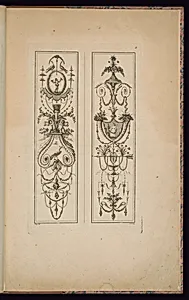
Two Arabesque Panel Designs
late 18th century
Classification
Department
Smithsonian Collection
Museum
Smithsonian American Art Museum
Credit
Purchased for the Museum by the Advisory Council
Accession Number
1921-6-308-7
Rights
Public Domain
About this artwork
Research in Progress
Art Historical Context
**Two Arabesque Panel Designs by Jean-Baptiste Fay, a French artist active from 1765 through the 1790s, exemplifies the ornate decorative spirit of late 18th France. Created during a period of transition from the lavish Rococo style to emerging Neoclassicism, these panel designs feature intricate arabesque motifs—flowing, interlaced patterns of foliage, scrolls, and fantastical elements. Such designs were highly sought after for adorning walls, furniture, architectural panels, reflecting the era's fascination with elegance and asymmetry in interior decoration. As a print, this work likely served as a reproducible template for artisans, allowing widespread dissemination of sophisticated designs amid France's thriving printmaking culture. Fay's contribution highlights how prints bridged fine art and applied crafts, influencing workshops across Europe. Though the exact medium remains under study, its classification underscores the technical precision of engraving or etching techniques that captured delicate lines and textures. Now housed in the Smithsonian American Art Museum, purchased by the Advisory Council, these designs offer a glimpse into transatlantic artistic exchanges. Ongoing research promises deeper insights, but they already captivate with their whimsical beauty, inviting visitors to appreciate the artistry behind everyday opulence.