
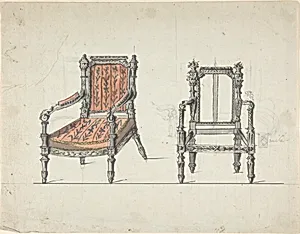
Two Carved-Wood Armchairs
19th century
Medium
Pen and ink, wash and watercolor, with traces of graphite on laid paper
Dimensions
sheet: 8 1/4 x 10 3/4 in. (21 x 27.3 cm)
Classification
Drawings
Department
Drawings and Prints
Museum
Metropolitan Museum of Art, New York, NY
Credit
The Elisha Whittelsey Collection, The Elisha Whittelsey Fund, 1966
Accession Number
66.630.70
Rights
Public Domain
Tags
Art Historical Context
This delicate 19th-century French drawing, titled *Two Carved-Woodchairs*, offers a glimpse into the opulent world of furniture design during a time when elaborate woodwork symbolized status and craftsmanship. Created anonymously by a skilled artist, the work depicts a pair of stately armchairs with intricate carvings, rendered on a modest sheet of laid paper measuring just 8¼ x 10¾ inches. Housed in the Metropolitan Museum of Art's Drawings and Prints department as part of The Elisha Whittelsey Collection (acquired in 1966), it exemplifies the precision of period design studies. The medium—pen and ink for fine lines, wash and watercolor for subtle shading, with traces of graphite—brings the chairs' ornate details to life, highlighting textures and contours typical of French 19th-century aesthetics. Such techniques were prized for their versatility in architectural and decorative arts drawings, allowing designers to convey depth and materiality on paper. These armchairs likely reflect the era's revival styles, blending functionality with artistic flourish amid France's cultural emphasis on luxury interiors. For visitors, this piece invites reflection on everyday elegance: how a simple sketch preserves the artistry of forgotten workshops, bridging 19th-century innovation with our modern appreciation for historical design.
About the Artist
Anonymous, French, 19th century · 1800–1900
**Anonymous, French, 19th Century (ca. 1800–1900)** The artist cataloged as Anonymous, French, 19th century embodies the enigmatic yet essential contributions of unidentified creators to France's vibrant 19th-century art world. Active roughly between 1800 and 1900, this figure—or potentially collective workshop—produced a diverse array of works amid the nation's transition from Neoclassicism thro...