
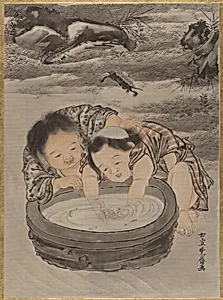
Two Children Playing with Goldfish
ca. 1887
Medium
Album leaf; ink and color on silk
Dimensions
14 1/4 x 10 3/8 in. (36.2 x 26.4 cm)
Classification
Paintings
Culture & Period
Japan · Meiji period (1868–1912)
Department
Asian Art
Museum
Metropolitan Museum of Art, New York, NY
Credit
Charles Stewart Smith Collection, Gift of Mrs. Charles Stewart Smith, Charles Stewart Smith Jr., and Howard Caswell Smith, in memory of Charles Stewart Smith, 1914
Accession Number
14.76.61.18
Rights
Public Domain
Tags
Art Historical Context
In the late Meiji period1868–1912), as Japan rapidly modernized under Western influences, artist Kawanabe Kyōsai captured timeless moments of childhood innocence in *Two Children with Goldfish* (ca. 1887). Kyōsai, often called the "last great painter" of traditional Japanese styles, blended ukiyo-e whimsy with dynamic ink lines and vivid colors. This album leaf, a compact format for personal albums, depicts two boys engrossed in their goldfish, evoking joy and curiosity amid Japan's cultural transformation. Rendered in ink and color on silk—a luxurious medium prized for its subtle sheen and absorbency—the painting showcases Kyōsai's masterful brushwork. His lively strokes bring movement to the fish and children's faces, highlighting his satirical yet affectionate view of everyday life. Goldfish, popular pets in Japan, symbolize fleeting beauty and playfulness, resonating with ukiyo-e themes of transience. Part of the Metropolitan Museum of Art's Asian Art collection, gifted in 1914 from the Charles Stewart Smith family, this intimate work invites visitors to appreciate Meiji-era nostalgia. At just 14¼ × 10⅜ inches, it reminds us how Kyōsai preserved Japan's artistic soul during times of change.
About the Artist
Kawanabe Kyōsai 河鍋暁斎 (Japanese) · 1831 –1889
Japanese, 1831–1889