
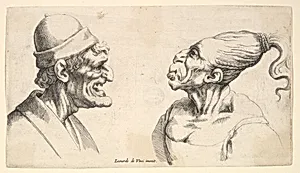
Two deformed heads
Medium
Engraving, only state
Dimensions
Sheet: 3 11/16 × 6 9/16 in. (9.4 × 16.7 cm)
Classification
Prints
Department
Drawings and Prints
Museum
Metropolitan Museum of Art, New York, NY
Credit
Purchase, Joseph Pulitzer Bequest, 1917
Accession Number
17.50.18-211
Rights
Public Domain
Tags
Art Historical Context
In the Metropolitan Museum of Art's Drawings and Prints department, *Two Deformed Heads* (1645–50) showcases a fascinating collaboration across centuries. This rare engraving, the only known state, reproduces Leonardo da Vinci's meticulous Renaissance sketches of grotesque human heads, captured by the masterful 17th-century Bohemian artist Wenceslaus Hollar. Measuring just 3 11/16 × 6 9/16 inches, the intimate sheet invites close inspection, revealing Leonardo's probing gaze into human anatomy and pathology. Leonardo, the quintessential Renaissance polymath, obsessively studied the body—normal and deformed alike—to perfect his art and science. These heads, likely from his later Milanese period, exemplify his fascination with facial distortions, blending scientific curiosity with a touch of the macabre, as seen in works like his *Grotesque Profiles*. Hollar, a virtuoso etcher exiled from Bohemia during the Thirty Years' War, faithfully translated Leonardo's fluid pen strokes into precise lines, preserving the master's genius for a wider audience amid the print boom of the Baroque era. Acquired through the Joseph Pulitzer Bequest in 1917, this print highlights engraving's power to democratize high art, bridging Leonardo's 15th-century innovations with 17th-century dissemination. A testament to enduring curiosity about the human form, it reminds us how da Vinci's unflinching realism continues to unsettle and inspire.
About the Artist
Leonardo da Vinci|Wenceslaus Hollar · 1452–1519
Leonardo da Vinci (1452-1519) stands as the quintessential Renaissance polymath, whose genius spanned painting, sculpture, architecture, science, mathematics, engineering, anatomy, geology, cartography, botany, and writing. Born in Vinci, Italy, as the illegitimate son of a notary, Leonardo received limited formal education but demonstrated extraordinary artistic talent from an early age. His appr...