
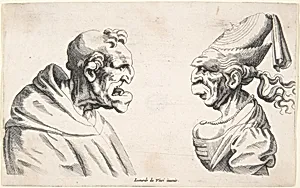
Two Grotesque Heads
Medium
Etching; only state
Dimensions
sheet (clipped impression): 4 3/16 x 6 5/8 in. (10.6 x 16.8 cm)
Classification
Prints
Department
Drawings and Prints
Museum
Metropolitan Museum of Art, New York, NY
Credit
Purchase, Joseph Pulitzer Bequest, 1917
Accession Number
17.50.18-164
Rights
Public Domain
Tags
Art Historical Context
"Two Grotesque Heads an exquisite etching from the 1640s, captures the Renaissance master's fascination with human expression through the skilled hand of Wenceslaus Hollar, a Bohemian engraver renowned for his meticulous reproductive prints. Attributed in part to designs by Leonardo da Vinci and possibly an anonymous Netherlandish artist, this sole-state impression reproduces dynamic profile studies of a male and female head, exaggerated into grotesque forms. Measuring just 4 3/16 x 6 5/8 inches on clipped paper, its intimate scale invites close inspection at the Metropolitan Museum of Art, acquired via the Joseph Pulitzer Bequest in 1917. Leonardo's original sketches, likely from his notebooks, exemplify his innovative approach to anatomy and caricature during the late 15th to early 16th centuries, blending scientific observation with playful distortion to explore emotion and character. Hollar's etching technique—using acid to bite fine lines into a copper plate—preserved these ideas with remarkable fidelity, translating Leonardo's fluid pen strokes into tonal depth and texture. This print bridged Renaissance innovation with 17th-century printmaking, making elite drawings accessible to collectors and scholars. As a highlight in the Met's Drawings and Prints department, it showcases the era's growing print culture, where etchings democratized art. Visitors will delight in its whimsical yet profound study of humanity's varied faces, a testament to art's enduring power to provoke and amuse.
About the Artist
Leonardo da Vinci|Anonymous, Netherlandish, 17th century|Wenceslaus Hollar · 1452–1519
Leonardo da Vinci (1452-1519) stands as the quintessential Renaissance polymath, whose genius spanned painting, sculpture, architecture, science, mathematics, engineering, anatomy, geology, cartography, botany, and writing. Born in Vinci, Italy, as the illegitimate son of a notary, Leonardo received limited formal education but demonstrated extraordinary artistic talent from an early age. His appr...