
Two Doorways
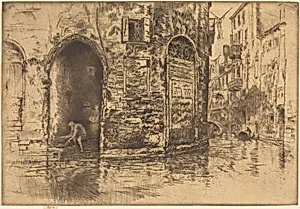
Medium
etching and drypoint in brownish-black ink on laid paper
Classification
Department
CG-W
Museum
National Gallery of Art, Washington, D.C.
Credit
Rosenwald Collection
Accession Number
1943.3.8526
Rights
Public Domain
Art Historical Context
James McNeill Whistler’s *Two Doorways* (1880) is a captivating etching and drypoint in brownish-black ink on laid, showcasing the artist’s mastery of printmaking. Whistler, an American-born painter and printmaker who thrived in Britain, was key figure in the Aesthetic, championing “art for art’s sake with his emphasis on harmony, tone, and subtle beauty over narrative detail. This work, part of the National Gallery of Art’swald Collection, exemplifies his urban architectural interests during a prolific period of experimentation in the late 19th century. Created through etching—where acid bites lines into a metal plate—and drypoint, a direct scratching technique that produces velvety burrs for rich, textured lines, the print evokes a moody, atmospheric quality. The brownish-black ink on laid paper, with its visible chain lines, adds to the tactile intimacy typical of fine 19th-century prints. Whistler’s spare composition of two doorways likely draws from European cityscapes, highlighting shadows and forms to create depth and mystery. As a print from Whistler’s Venice series (1879–80), *Two Doorways* reflects his fascination with decay and light in historic settings, influencing later modernists like Picasso. Its subtle tonal range invites viewers to linger, appreciating the artistry in simplicity—a perfect gem for print enthusiasts. (198 words)
About the Artist
James McNeill Whistler · 1834–1903
James Abbott McNeill Whistler (1834-1903) was an American-born painter and printmaker who became a leading figure in the Aesthetic Movement and pioneer of Tonalism and Japonisme. He revolutionized art by championing "art for art's sake" and treating paintings as visual equivalents of musical compositions, titling works as "arrangements," "harmonies," and "nocturnes" to emphasize formal qualities o...