
Two Draft Horses with a Sleeping Driver
1820–22
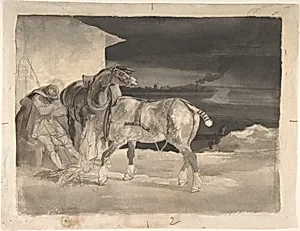
Medium
Brush and brown and gray wash, over graphite
Dimensions
11 3/4 x 15 1/16 in. (29.9 x 38.2 cm)
Classification
Drawings
Department
Drawings and Prints
Museum
Metropolitan Museum of Art, New York, NY
Credit
Purchase, Joseph Pulitzer Bequest and Harry G. Sperling Fund, 1996
Accession Number
1996.365
Rights
Public Domain
Tags
Art Historical Context
In the quiet intimacy of Théodore Géricault's *Two Draft Horses with a Driver* (1820–22), we glimpse the French Romantic master's fascination with equine power and human vulnerability. Created just years before Géricault's untimely death at age 32, this drawing captures two sturdy draft horses standing patiently while their driver slumbers, evoking a tender, almost humorous moment from rural life. Housed in the Metropolitan Museum of Art's Drawings and Prints department, it measures a modest 11 3/4 x 15 1/16 inches, inviting close contemplation of its subtle narrative. Géricault, renowned for his turbulent masterpiece *The Raft of the Medusa* (1818–19), was a pioneer of Romanticism, blending raw emotion with anatomical precision—especially in his studies of horses, which recur throughout his oeuvre. Here, he employs brush and brown and gray wash over graphite, a fluid technique that builds dramatic tonal contrasts and soft shadows, mimicking the play of light on flesh and muscle. This method allowed rapid, expressive sketches, bridging preparatory work and standalone artistry, and highlights his skill in rendering texture—from the horses' coarse manes to the driver's relaxed form. Acquired in 1996 through the Joseph Pulitzer Bequest and Harry G. Sperling Fund, this piece offers a serene counterpoint to Géricault's more ferocious visions, reminding us of the everyday poetry he found in the bond between man and beast. A perfect gem for lovers of Romantic draftsmanship!
About the Artist
Théodore Gericault · 1791–1824
Théodore Géricault, born Jean-Louis André Théodore Géricault on September 26, 1791, in Rouen, France, into a prosperous family—his father a lawyer turned tobacco merchant and his mother from a line of growers—moved to Paris around 1797. Displaying early artistic promise, recognized by painter Jean-Louis Laneuville, he began formal training in 1808 under Carle Vernet, mastering English sporting art...