
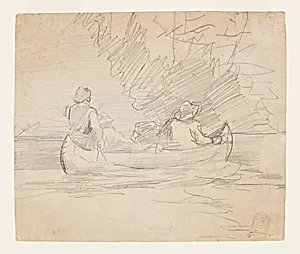
Canoe with Three Men
Classification
landscapes
Department
Smithsonian Collection
Museum
Smithsonian American Art Museum
Credit
Gift of Charles Savage Homer, Jr.
Accession Number
1912-12-229
Rights
Public Domain
About this artwork
Research in Progress
Art Historical Context
Winslow Homer’s "Canoe with Three Men," painted in 1897 captures a quiet moment of human presence within the natural world. Homer, one of America’s most celebrated Realist artists, devoted much of his later career to scenes of outdoor life, often focusing on water, weather, and the subtle drama of ordinary activities. The work belongs to the broad category of American landscape painting, a genre that helped define national identity in the decades following the Civil War. Created just over a decade before Homer’s death, the painting reflects his mature interest in the relationship between people and the wilderness. Though the exact medium remains under study, the Smithsonian American Art Museum holds the piece as part of a generous gift from the artist’s brother, Charles Savage Homer, Jr. Visitors today can appreciate how Homer’s straightforward approach transformed everyday subjects into enduring symbols of American experience. Research on this particular canvas is ongoing, yet its inclusion in the museum’s collection underscores Homer’s lasting influence on how artists portray the American landscape.