
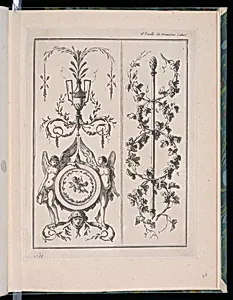
Two Ornament Panel Designs
Medium
Classification
Department
Smithsonian Collection
Museum
Smithsonian American Art Museum
Credit
Purchased for the Museum by the Advisory Council
Accession Number
1921-6-481-41
Rights
Public Domain
About this artwork
Research in Progress
Art Historical Context
Jean-Baptiste Huet, a prominent French artist of the late Rococo era (1745–1811), created *Two Ornament Panel Designs between 1776 and1789. Working in the vibrant artistic circles of pre-Revolutionary Paris, Huet was renowned for his delicate, nature-inspired decorations, often featuring flora, fauna, and playful motifs. These prints capture the opulent taste of 18th-century French decorative arts, when ornate paneling adorned the walls of châteaux and salons, blending elegance with whimsy. As etchings or engravings—a common print medium of the time—these designs served practical purposes, allowing architects, furniture makers, and tapestry weavers to replicate intricate patterns affordably. Huet's style, rooted in the Rococo movement's love for asymmetry and organic forms, bridged the lush curves of the mid-century with emerging Neoclassical restraint. His works influenced manufactures like those at Beauvais, where such panels brought pastoral fantasies indoors. Today, housed in the Smithsonian American Art Museum and purchased by the Advisory Council, these designs offer a window into France's gilded age of ornamentation. Though research continues, they highlight how prints democratized high art, making luxury accessible beyond royal courts. Visitors will appreciate their timeless charm and the artist's skill in evoking nature's bounty.