
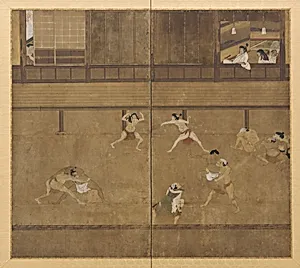
Two-panel screen depicting wrestlers
17th century
Classification
Painting
Department
Smithsonian Collection
Museum
Smithsonian American Art Museum
Credit
Gift of Charles Lang Freer
Accession Number
F1903.100
Rights
Public Domain
Tags
About this artwork
Pairs of wrestlers in a walled courtyard engage in practice bouts of sumo, the ancient Japanese form of wrestling that became a professional sport early in the Edo period (1615-1868), when this screen was painted. Still practiced today as Japan's most famous national sport, sumo has a history of some two thousand years, and formal matches retain many of the rituals established in ancient times.
Art Historical Context
This vibrant two-panel screen, created by an unknown artist in 17th-century Japan during the Edo period (5–1868), captures pairs of sumo wrestlers engaged in practice bouts within a walled courtyard. As a painted screen—a traditional Japanese *byōbu* format—the artwork likely served as a decorative folding partition in a home or tea house, blending artistry with everyday cultural scenes. Its classification as a painting highlights the era's mastery of ink and pigment on silk or paper, evoking the lively, observational spirit of *ukiyo-e*, the "pictures of the floating world" that celebrated transient pleasures like sports and entertainment. Sumo, Japan's ancient national sport with roots stretching back some 2,000 years, gained professional status early in the Edo period, making this depiction a snapshot of its rising popularity. The wrestlers' dynamic poses and the enclosed setting reflect the ritualistic discipline of the sport, where formal matches today still preserve ancient Shinto-inspired ceremonies, from salt purification to rhythmic stomping. Generously gifted to the Smithsonian American Art Museum by collector Charles Lang Freer, this piece from the Freer collection offers visitors a window into Edo Japan's vibrant street life, underscoring sumo's enduring role as a symbol of strength, tradition, and national pride.
About the Artist
Unknown
The artist designated as "Unknown" in our virtual museum's collection exemplifies a poignant chapter in art history: creators whose identities have faded into obscurity despite the enduring power of their work. With only one known artwork attributed to them in our holdings, this figure represents countless anonymous hands that shaped visual culture across centuries. Museums worldwide, including th...