
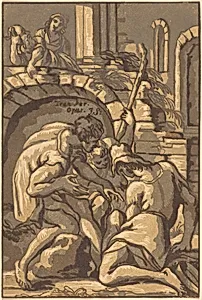
Two Shepherds and a Boy
1781-1783
Medium
color chiaroscuro woodcut on laid paper
Dimensions
sheet: 29 × 19.4 cm (11 7/16 × 7 5/8 in.)
Classification
Department
CG-E
Museum
National Gallery of Art, Washington, D.C.
Credit
Rosenwald Collection
Accession Number
1947.12.45
Rights
Public Domain
Art Historical Context
**Two Shepherds and a** (1781–1783) is a charming color chiaroscuro woodcut by Skippe, an English printmaker and antiquarian (1742–1811). Printed on laid paper, this intimate sheet measures 29 × 19.4 cm and captures a pastoral scene of two shepherds conversing with a boy amid a rustic landscape. Skippe, fascinated by Renaissance techniques, created this during a late-18th-century revival of woodcut printing in Britain, when such prints were rare outside academic circles. The chiaroscuro technique—using multiple woodblocks for a "light-dark" effect—lends dramatic depth and subtle color tones, mimicking the chiaroscuro of oil paintings by masters like Rembrandt or Correggio, whom Skippe admired. Here, a key block outlines forms while tone blocks add earthy hues, showcasing the woodcut's potential for painterly illusion on humble paper. This medium highlighted printmaking's accessibility, bridging fine art and popular imagery. Housed in the National Gallery of Art's Rosenwald Collection, the work reflects Enlightenment-era nostalgia for rural idylls amid industrialization. Skippe's self-taught precision exemplifies how 18th-century gentlemen artists democratized sophisticated techniques, inviting viewers to savor simple joys in shadow and light.
About the Artist
John Skippe · 1742–1811
John Skippe, also known as Skipp, was an English amateur artist born on 7 July 1741 in Ledbury, Herefordshire, as the son of John Skipp of Upper Hall. His family had deep roots in the area, with ancestors supporting local causes in the seventeenth century. He matriculated at Merton College, Oxford, in 1760 at age eighteen. After university, Skippe traveled through northern Italy, where he produced...