
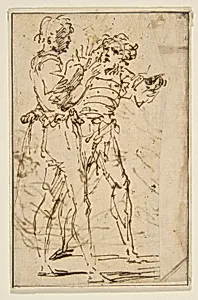
Two Standing Men Gesticulating
1615–73
Medium
Pen and brown ink. Pen scribbles on verso are indistinctly visible on recto
Dimensions
5-1/4 x 3-1/16 in. (13.3 x 7.7 cm) (irregular)
Classification
Drawings
Department
Drawings and Prints
Museum
Metropolitan Museum of Art, New York, NY
Credit
Gift of Harry G. Friedman, 1960
Accession Number
60.66.13
Rights
Public Domain
Tags
Art Historical Context
**Two Standing Men Gestic** by Salvator Rosa (1615–1673) is a lively pen and brown ink drawing that captures two figures in animated conversation. Measuring just 5-1/4 x 3-1/16 inches (13.3 x 7.7 cm), its irregular edges and small scale suggest it was a spontaneous sketch, possibly a study for a larger composition. Faint pen scribbles from the verso faintly show through, adding a layer of tactile intrigue to this intimate work from the Metropolitan Museum of Art's Drawings and Prints department, gifted by Harry G. Friedman in 1960. Rosa, a prominent Italian Baroque artist from Naples, was renowned for his dramatic, energetic style influenced by Caravaggio and the Carracci. His drawings often feature bold, expressive figures like these gesticulating men, emphasizing movement and emotion through swift, hatched lines in brown ink—a technique that conveys volume and vitality with economical strokes. Unlike his grand landscapes or battle scenes, this piece highlights Rosa's skill in figure studies, which informed his paintings and etchings. This modest yet masterful sheet exemplifies the Baroque fascination with human dynamism and theatricality, reflecting 17th-century Italy's cultural emphasis on gesture as a language of passion. Visitors will appreciate its raw energy, a window into an artist's quick hand at work.
About the Artist
Salvator Rosa · 1615–1673
Salvator Rosa was born in 1615 in Arenella, on the outskirts of Naples, into a world of artistic ambition and turbulent talent. His early training came through his maternal uncle, the painter Paolo Greco, and his brother-in-law Francesco Fracanzano, himself a pupil of the great Spanish-born Neapolitan master Jusepe de Ribera. Rosa showed a fierce independence from the start, resisting his father's...