
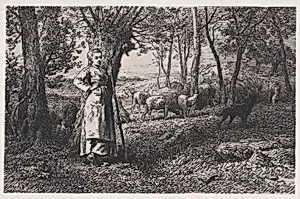
La Bergère
1868
Medium
Etching
Dimensions
Plate: 7 5/16 × 9 13/16 in. (18.5 × 25 cm) Image: 4 15/16 × 7 3/4 in. (12.6 × 19.7 cm)
Classification
Prints
Department
Drawings and Prints
Museum
Metropolitan Museum of Art, New York, NY
Credit
Harris Brisbane Dick Fund, 1927
Accession Number
27.10.75
Rights
Public Domain
Art Historical Context
Charles Jacque’s 1868 etching *La Bergère* captures a quiet moment of rural life through the delicate lines of the print medium. The French artist, celebrated for his sensitive depictions of animals and countryside scenes, portrays a shepherdess tending her flock, inviting viewers to appreciate the simple rhythms of pastoral existence. Created during a period when many artists turned toward realism and direct observation of nature, the work reflects the era’s growing interest in everyday rural subjects. Etching proved especially well suited to Jacque’s vision. The technique allowed him to achieve fine tonal gradations and lively textures—particularly in rendering wool, foliage, and fabric—with remarkable economy of line. Because etchings could be produced in multiples, works like this one helped bring intimate views of the French countryside to a wider audience beyond the walls of the Salon. Today the print resides in the Metropolitan Museum’s collection of drawings and prints, where its modest scale (roughly 5 by 8 inches) rewards close looking. Jacque’s careful attention to light and atmosphere continues to offer modern viewers a tranquil window onto nineteenth-century rural France.
About the Artist
Charles Jacque · 1813–1894
Charles-Émile Jacque (1813–1894) was a pioneering French painter, engraver, and illustrator whose career bridged the worlds of printmaking and pastoral painting. Born in Paris amid a difficult childhood, he apprenticed at age seventeen to a map engraver, mastering drypoint technique and producing his first etching in 1830—a copy of a head after Rembrandt. After serving seven years in the French Ar...