
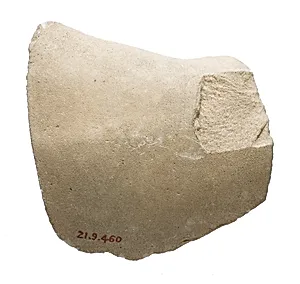
Unidentified fragment
Unknown Artist
ca. 1353–1336 B.C.
Medium
Limestone
Dimensions
H. 10.5 × W. 11 × D. 2.8 cm (4 1/8 × 4 5/16 × 1 1/8 in.)
Classification
Unidentified, relief (?), inlay (?)
Period
New Kingdom, Amarna Period
Department
Egyptian Art
Museum
Metropolitan Museum of Art, New York, NY
Credit
Gift of Edward S. Harkness, 1921
Accession Number
21.9.460
Rights
Public Domain
Art Historical Context
This small limestone fragment dates to the Amarna Period of Egypt’s New Kingdom, roughly 1353–1336 B.C., during the reign of the pharaoh Akhenaten. Created in Dynasty 18, piece belongs to a moment of profound artistic and religious change, when traditional Egyptian styles gave way to more naturalistic forms, elongated figures, and an emphasis on the sun disk Aten. Even in its unidentified state, the fragment offers a tangible link to this brief but transformative era. Limestone was a favored medium for relief carving in ancient Egypt because it was readily available along the Nile and could be finely detailed with chisels and abrasives. Artisans often worked on temple walls or private monuments, capturing scenes of daily life, royal processions, or offerings. Though only 10.5 centimeters tall, this fragment’s subtle modeling hints at the period’s distinctive aesthetic—softened contours and a sense of movement that set Amarna art apart from earlier, more rigid conventions. Preserved through the generosity of Edward S. Harkness, the piece now resides in the Metropolitan Museum’s Egyptian Art collection. Such modest remnants remind visitors that every shard contributes to our understanding of a civilization whose creative innovations continue to fascinate.