
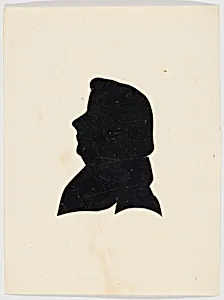
Unidentified profile portrait, man facing left
1773–1820
Medium
Cut black paper silhouette
Dimensions
5 3/16 × 3 7/8 in. (13.2 × 9.8 cm)
Classification
Cut Paper
Department
Drawings and Prints
Museum
Metropolitan Museum of Art, New York, NY
Credit
Gift of Leopold Heinemann, 1948, transferred from the Library
Accession Number
2013.141.2
Rights
Public Domain
Tags
Art Historical Context
This delicate cut-paper silhouette captures the profile of an unidentified man facing left, crafted by an anonymous German artist 1773 and 1820. Measuring just 5 3/16 × 3 7/8 inches, its intimate scale suggests it was likely a personal keepsake, perhaps for a locket or. The medium—black paper meticulously scissored to define the subject's sharp features, hair, and clothing—exemplifies the precision and artistry of silhouette portraiture, a technique that relied on bold contrasts and negative space to convey likeness without color or detail. Popular in late 18th- and early 19th-century Europe, especially Germany, silhouettes offered an affordable alternative to oil paintings or miniatures, democratizing portraiture for the rising middle class. Rooted in folk paper-cutting traditions like Scherenschnitte, these works were often produced swiftly by itinerant artists at fairs or homes, making them a snapshot of everyday life before photography's invention in the 1830s. This example, now in the Metropolitan Museum of Art's Drawings and Prints department (gift of Leopold Heinemann, 1948), highlights the ephemeral charm of such crafts, preserved as a testament to vernacular artistry. Though the sitter remains unknown, the silhouette invites us to ponder his story—a gentleman of the Enlightenment era, evoked through a single, elegant cut.