
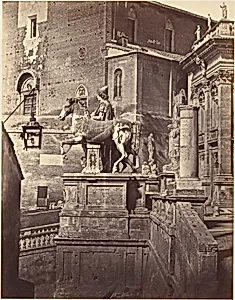
Uno dei Colossi di Campedoglio
1848–52
Medium
Albumen print from glass negative
Dimensions
Image: 11 5/16 × 8 11/16 in. (28.8 × 22 cm) Sheet: 18 1/2 × 12 1/8 in. (47 × 30.8 cm)
Classification
Photographs
Department
Photographs
Museum
Metropolitan Museum of Art, New York, NY
Credit
Gilman Collection, Museum Purchase, 2005
Accession Number
2005.100.799 (15)
Rights
Public Domain
Tags
Art Historical Context
In the mid-19th century, photographer Eugène Constant captured grandeur of Rome's ancient wonders with *Uno dei Colossi di Camped* (One of the Colossi the Capitoline), created between 1848 and 1852. This albumen print depicts one of the massive ancient sculptures adorning the Capitoline Hill a site central to Roman history and mythology. These "colossi"—likely referencing monumental figures like the Dioscuri or other oversized statues—stood as symbols of imperial power, relocated to the Capitoline piazza during the Renaissance to enhance Michelangelo's architectural masterpiece. Constant's image exemplifies early photography's role in documenting archaeology. Produced as an albumen print from a glass negative, it showcases the medium's breakthrough: egg-white sensitized paper yielded sharp, rich details unattainable by earlier daguerreotypes. At 11 5/16 × 8 11/16 inches, the print preserves the sculpture's dramatic scale and weathered textures against Rome's timeless skyline, inviting viewers to study classical art up close. Today, housed in the Metropolitan Museum of Art's Gilman Collection, this photograph bridges 19th-century innovation with antiquity. It highlights how photographers like Constant fueled the era's fascination with the Grand Tour, making Rome's treasures accessible to scholars and travelers worldwide. A testament to photography's preservative power, it reminds us of the Colosseum-like might of these enduring giants.
About the Artist
Eugène Constant · 1848–1855
Eugène Constant (before 1820 – after 1860) was a French painter who became one of the pioneering photographers of the 19th century, capturing the grandeur of Italy's ancient monuments with unprecedented clarity.) Trained as a painter in Paris during the early 1840s, where he maintained a studio at 31 rue du Marché-Saint-Honoré, Constant exhibited interior views of Venice's Basilica of San Marco an...