
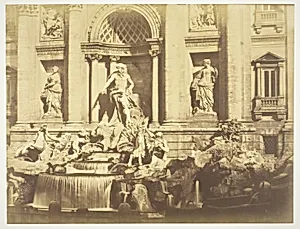
Fountain of Neptune
c. 1857
Medium
Albumen print, from "Photographs of Views of Rome" (c. 1857)
Dimensions
Image/paper: 28.8 × 37.5 cm (11 3/8 × 14 13/16 in.); Mount: 40.2 × 45.5 cm (15 7/8 × 17 15/16 in.)
Classification
photograph
Department
Photography and Media
Museum
Art Institute of Chicago
Accession Number
217187
Rights
Public Domain
Art Historical Context
Step into the sun-drenched grandeur of Renaissance Rome with Robert MacPherson *Fountain of Neptune* (c. 1857), an albumen print from his series *Photographs of Views of Rome*. This Scottish photographer, who settled in the Eternal City in the 1840s, masterfully captured the city's architectural treasures using the era's cutting-edge wet-collodion process on glass negatives. Printed on albumen-sensitized paper—coated with egg whites for its luminous tones and fine detail—the image measures 28.8 × 37.5 cm, mounted to preserve its archival elegance. MacPherson's work emerged during the mid-19th-century "paper negative" revolution, bridging painting's romanticism with photography's precision. The Fountain of Neptune, a Baroque marvel likely referencing Giacomo della Porta's 16th-century design in Piazza Navona, symbolizes Neptune's dominion over the seas amid Rome's lively urban tapestry. These prints were prized souvenirs for Grand Tour travelers, democratizing access to Italy's heritage before mass tourism. Housed in the Art Institute of Chicago's Photography and Media department, this piece highlights photography's role in preserving vanishing antiquities, blending technical innovation with timeless beauty. A testament to MacPherson's eye for light and scale, it invites us to linger on cascading waters frozen in silvered perfection.
About the Artist
Robert MacPherson · 1811–1872
Robert Macpherson (1811–1872) was a Scottish artist who began his career in medicine before pivoting to painting and ultimately pioneering photography in Rome. Born in the Tayside region near Edinburgh, he enrolled at the University of Edinburgh in 1831 to study medicine but left without graduating after four years. He then trained at the Royal Scottish Academy, where he exhibited portraits from 1...