
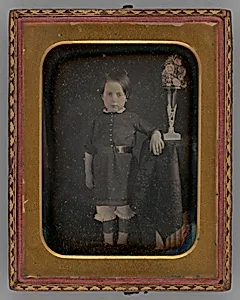
Untitled (Portrait of a Standing Boy)
1848
Medium
Daguerreotype
Dimensions
10.7 × 8.2 cm (4 1/4 × 3 1/4 in.); Case, no cover: 11.8 × 9.3 × 1 cm (4 11/16 × 3 11/16 × 7/16 in.); Plate: 10.8 × 8.3 cm (4 1/4 × 3 1/4 in.)
Classification
portrait
Department
Photography and Media
Museum
Art Institute of Chicago
Accession Number
250013
Rights
Public Domain
Art Historical Context
This poignant *Untitled (Portrait of a Standing Boy)*, created in 1848 by an unknown maker, captures a moment of quiet dignity in one of photography's earliest forms: the daguerreotype. Measuring just 10.7 × 8.2 cm, this intimate image on a silvered copper plate presents a young boy standing solemnly, his gaze meeting the viewer directly. Housed in the Art Institute of Chicago's Photography and Media Department, it exemplifies the portrait classification that dominated early photography. The daguerreotype process, introduced by Louis Daguerre in 1839, marked a revolutionary leap from painting, producing exquisitely detailed, one-of-a-kind positives with a mirror-like sheen. By 1848, these small-scale portraits had become wildly popular across Europe and America, offering middle-class families an affordable way to preserve loved ones' likenesses—far quicker and cheaper than oil paintings. No reproductions were possible, making each image uniquely precious. Culturally, this anonymous boy's portrait reflects photography's democratizing power, immortalizing everyday lives during a time of rapid industrialization and social change. Its modest case (sans cover) hints at intimate, personal use, inviting us to ponder the child's story and the era's blend of innovation and sentimentality. A window into 19th-century humanity through a tiny frame.