
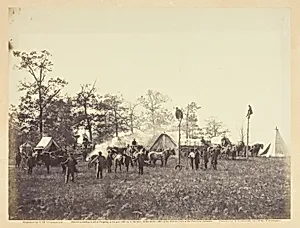
U.S. Military Telegraph Construction Corps
April 1864
Medium
Albumen print, pl. 62 from the album "Gardner's Photographic Sketch Book of the War, Volume II" (1866)
Dimensions
Image/paper: 17.3 × 22.3 cm (6 13/16 × 8 13/16 in.); Album page: 31.1 × 44 cm (12 1/4 × 17 3/8 in.)
Classification
photograph
Department
Photography and Media
Museum
Art Institute of Chicago
Accession Number
196202
Rights
Public Domain
Art Historical Context
Captured in April 1864 amid the American Civil War, *U.S. Military Telegraph Construction Corps by Timothy O'Sullivan offers a rare glimpse into the unsung logistical backbone of the Union Army. O'Sullivan, a pioneering photographer who worked with Mathew Brady and later Alexander Gardner, documented the war's gritty realities from the front lines. This albumen print, plate 62 from Gardner's landmark 1866 publication *Photographic Sketch Book of the, Volume II*, depicts soldiers erecting telegraph poles—a critical innovation that enabled rapid battlefield communication over vast distances. The albumen process, using egg whites to bind light-sensitive chemicals on paper, produced the era's sharpest, richest prints, making this modest 17.3 × 22.3 cm image a technological marvel. O'Sullivan's straightforward composition highlights the workers' determination, transforming a mundane task into a symbol of wartime ingenuity and endurance. Telegraph lines were lifelines for generals like Ulysses S. Grant, revolutionizing command during campaigns like the Overland Campaign. Housed in the Art Institute of Chicago's Photography and Media department, this photograph underscores photography's emerging role as a historical witness. It reminds us that victory often hinged on such invisible efforts, blending documentary precision with profound cultural resonance for future generations.
About the Artist
Timothy O'Sullivan · 1840–1882
Timothy H. O'Sullivan (c. 1840–1882) emerged as one of America's pioneering photographers during a transformative era. His early life remains sparsely documented, with records suggesting he was born either in New York City or Ireland before immigrating young, possibly growing up on Staten Island. As a teenager, he apprenticed under Mathew Brady at his Fulton Street gallery in New York, mastering w...