
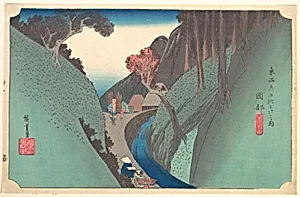
東海道五十三次之内 岡部 宇津の山|Utsu Hill at Okabe
Medium
Woodblock print; ink and color on paper
Dimensions
9 x 14 in. (22.9 x 35.6 cm)
Classification
Prints
Culture & Period
Japan · Edo period (1615–1868)
Department
Asian Art
Museum
Metropolitan Museum of Art, New York, NY
Credit
The Howard Mansfield Collection, Purchase, Rogers Fund, 1936
Accession Number
JP2489
Rights
Public Domain
Tags
Art Historical Context
Utagawa Hiroshige's *Utsu Hill at Okabe* (1834) is a woodblock print from his series *The Fifty-three of the Tōkaidō*. This Edo-period masterpiece depicts one of the challenging post stations along the historic Tōkaidō road, the vital coastal route connecting Edo (modern Tokyo) to Kyoto. Produced during a time when travel prints surged in popularity, it captures the arduous ascent of Utsu Hill, blending everyday travelers with the rugged landscape of hills and trees. Hiroshige, a master of the ukiyo-e ("pictures of the floating world") style, excels here in his signature techniques: vibrant inks and colors layered on paper through intricate woodblock carving. The composition draws the eye upward along the steep path, where human figures—likely porters and pilgrims—navigate the incline amid lush foliage, evoking the physical and poetic journey of the era's road travelers. At 9 x 14 inches, its intimate scale made it accessible to a wide audience, from merchants to samurai. This print's cultural resonance lies in romanticizing Japan's feudal travel culture, fostering a sense of wanderlust. Acquired through The Howard Mansfield Collection at the Metropolitan Museum of Art, it exemplifies Hiroshige's enduring influence on global art, inspiring later Impressionists like Monet with its atmospheric depth and natural harmony.
About the Artist
Utagawa Hiroshige · 1826–1869
Utagawa Hiroshige (1797–1858), born Andō Tokutarō, was the last great master of Japanese ukiyo-e woodblock printmaking and one of the most influential landscape artists in history. Born in Edo (modern Tokyo) into a low-ranking samurai family serving as fire wardens, Hiroshige transformed landscape printmaking into a poetic meditation on nature, weather, and everyday life. His revolutionary approac...