
Valentine
ca. 1880
Medium
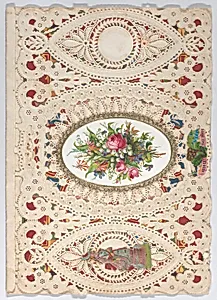
Cameo-embossed open-work lace paper, chromolithography, die-cut scrap, gilded paper edging
Dimensions
Width: 7 5/16 in. (18.6 cm) Length: 5 1/4 in. (13.4 cm)
Classification
Ephemera|Drawings|Ornament & Architecture
Department
Drawings and Prints
Museum
Metropolitan Museum of Art, New York, NY
Credit
Gift of Mrs. Richard Riddell, 1981
Accession Number
1981.1136.656
Rights
Public Domain
Art Historical Context
This delicate Valentine card, created around 1880 by an artist, exemplifies the ornate ephemera of the Victorian era. Measuring just 7 5/16 by 5 1/4 inches, it was designed as a romantic token, likely exchanged on February 14th during the height of Valentine's Day popularity in Europe and America. Housed in the Metropolitan Museum of Art's and Prints department, it entered the collection as a gift from Mrs. Richard Riddell in 1981. Crafted with sophisticated techniques, the card features cameo-embossed open-work lace paper, mimicking fine lace through raised relief and intricate cutouts for a lightweight, ethereal quality. Chromolithography brought vibrant colors to life via multi-layered stone printing, while die-cut scraps added dimensional pop-up elements, and gilded paper edging lent a luxurious golden shimmer. These methods, enabled by industrial advances, transformed mass-produced paper into affordable yet extravagant heirlooms. In Victorian culture, such cards symbolized sentimental romance amid strict social norms, blending heartfelt messages with elaborate decoration. This piece captures a fleeting moment of joy, reminding us how everyday rituals like Valentine's Day fostered personal connections through artistry.
About the Artist
Anonymous
In the vast tapestry of art history, "Anonymous" stands not as a singular individual but as a collective designation for countless unidentified creators whose works have endured across millennia. These artists, spanning prehistoric cave painters to medieval illuminators and folk craftsmen, produced the foundational layers of human visual culture. Prior to the Renaissance, when individual fame emer...